

Fleet management in Austria: what companies should watch with tracking and privacy
Introduce GPS tracking in the fleet in a privacy-compliant way: GDPR, ArbVG, works agreement and team communication, what Austrian companies should know.

Is GPS tracking of company vehicles allowed in Austria?
In principle yes, under conditions: it needs a legitimate purpose (for example dispatch, logbook, site protection), transparency towards drivers and data-sparing settings. If tracking as a control measure touches human dignity, the Labour Constitution Act requires works-council consent via a works agreement; without a works council, involving employees is the required path.
GPS tracking in the fleet sits in Austria in a clear legal framework: it is lawful if purpose, transparency and co-determination are right, and it becomes a problem if any of those is missing. This guide summarises what matters. It does not replace legal advice, but it restates the frame in which a clean introduction moves.
Why this is more than a formality
Vehicle tracking inevitably produces data with a personal link: where a company vehicle drives, a person is usually driving. Two sets of rules therefore apply at once: the GDPR for processing and Austrian employment law for control at the workplace. Anyone who ignores both risks not only fines and evidence problems, but loses something harder to repair: the team’s trust. The good news: the requirements are achievable and largely match what would be good management anyway.
The GDPR side: purpose, data minimisation, transparency
Three principles carry privacy-compliant tracking:
Purpose limitation. Tracking needs a documented, legitimate purpose: dispatch and tour planning, automatic logbook, assignment evidence, protection against unauthorised vehicle use. “We’ll collect everything for now” is not a purpose. The defined purpose also limits what may be done with the data. Anyone who introduces tracking for dispatch may not quietly repurpose it for performance scoring.
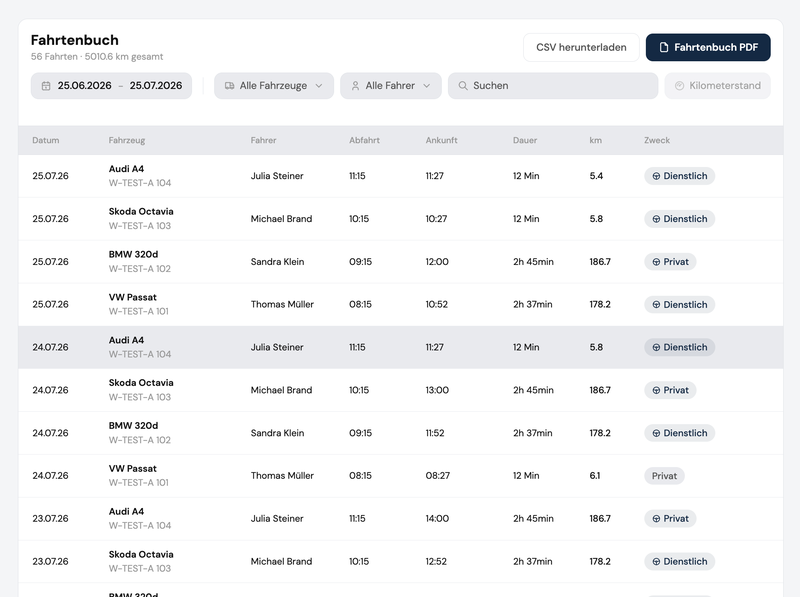
Data minimisation. Capture and retain only what the purpose requires. In practice that means: defined deletion periods, a role and access concept (not everyone sees everything), and where private use is allowed a solution that takes private trips out of capture.
Transparency. Drivers must know that tracking takes place, what is captured, for what, who has access and how long it is stored. That belongs in a written privacy notice, not in corridor talk.
On top comes the documentation duty: processing belongs in the record of processing activities; depending on the design a data-protection impact assessment may be needed. EU data hosting simplifies compliance considerably. TrackLog stores all data in the EU.
The employment-law side: co-determination under the ArbVG
Specific to Austria and in practice the most important point: the Labour Constitution Act (ArbVG) gives the works council co-determination rights over control measures. If a control measure touches human dignity, and continuous tracking can do that depending on design, it is only lawful under § 96 ArbVG with works-council consent: a works agreement is needed that regulates purpose, scope, access and analysis limits.
In companies without a works council this formal hurdle falls away, but not the substance: transparent information is a GDPR duty, and depending on intensity the consent of the individual employees is the legally safer path. Rule of thumb: the closer tracking is to controlling the behaviour of individuals, the higher the requirements. The more clearly it aims at the vehicle, dispatch and documentation, the less problematic.
When in doubt: works agreements and edge cases (private use, recording working time via tracking) belong in specialist hands, employment-law advice or a data-protection professional.
Transparency in the team: the underestimated success condition
Legal compliance is the duty; acceptance is the extra that decides usefulness. A simple line has proven itself: say openly what the system does, and write down what it does not do. A sentence such as “The data serve dispatch, logbook and vehicle protection and are not used for individual performance scoring” takes the edge off introduction and binds management at the same time.
How team communication fits into the introduction sequence is shown step by step in introducing GPS in the fleet in 30 days.
Specific to Austria: EU hosting, local support, fitting documents
For Austrian companies a provider with an Austria focus has practical advantages: a de-AT interface and support, EU data hosting without third-country complications, logbook exports that fit local accounting practice, and functions such as geofencing for border crossings, relevant for example in vehicle rental. TrackLog is an Austrian system (TrackLog System GmbH, Vienna) with data hosted in the EU; details on the features page and under privacy.
Checklist for a clean introduction
- Define the purpose in writing (and what is excluded)
- Prepare a privacy notice for the team
- Involve the works council or inform employees; for control measures: works agreement
- Set a role and access concept
- Define deletion periods, update the record of processing
- Regulate private use (exclude/anonymise capture)
- Only then: install devices
Conclusion
GPS tracking and privacy are not a contradiction in Austria. They only require the right order: purpose, transparency and co-determination before the technology. Anyone who works through the checklist introduces a system that holds legally and is carried by the team.
Frequently asked questions
Is a works agreement needed for GPS tracking?
May privately used company cars be tracked?
Where must tracking data be stored?
How long may trip data be retained?
Does this article replace legal advice?
See the fleet live. Today.
The device arrives by post. Plugged in in under 1 minute, cancel monthly.
Order now